

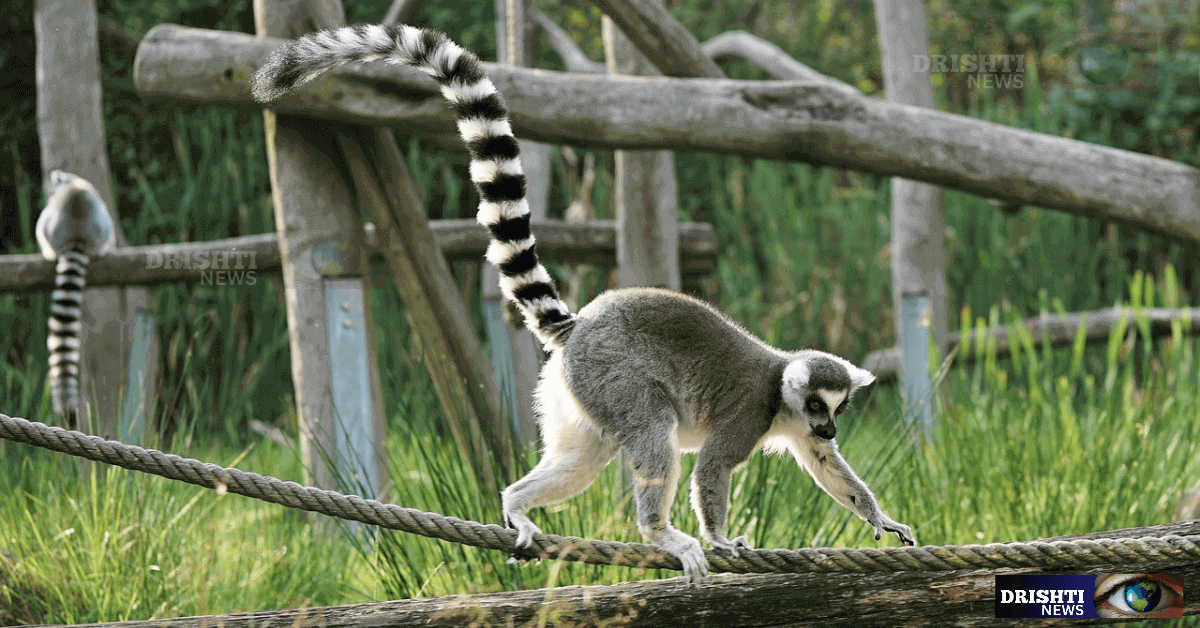
The ring-tailed lemur (Lemur catta) is a fascinating and distinctive primate species native to the island of Madagascar. Named for its striking black and white striped tail, this lemur species boasts several interesting characteristics.
They are highly social creatures, living in troops of up to 30 individuals, and they communicate through a combination of vocalizations, body postures, and tail movements. Measuring around 15-18 inches in body length, the ring-tailed lemur’s tail can reach up to 22 inches, longer than its body. This tail serves various functions, such as communication through scent marking and balancing while leaping between trees.
Their tail serves another crucial purpose beyond communication and balance – it plays a vital role in keeping their group members together while traveling. When a troop of ring-tailed lemurs is on the move, the leader often takes the lead and, interestingly, holds its tail up high like a flag.
This raised tail acts as a visual signal for the rest of the group, helping them maintain cohesion and stay together as they move through their forested habitat. By following the leader’s tail, the other lemurs can easily track the troop’s path and stay close, reducing the risk of getting separated and lost. This behavior is especially important when traversing challenging terrain or searching for food and water sources.
One fun fact about ring-tailed lemurs is their love for sunbathing. In the mornings, they often sit in a “sun-worshipping” position, spreading their arms and legs wide open to soak up the sun’s warmth. This behavior is believed to help regulate their body temperature and stimulate vitamin D production.
Their diet is diverse and primarily vegetarian, consisting of fruits, leaves, flowers, and even small insects. Interestingly, they have a specialized toothcomb to groom themselves and extract substances like gum and sap from trees.
Unfortunately, ring-tailed lemurs face numerous threats, including habitat loss due to deforestation and agricultural expansion, as well as being hunted for the illegal pet trade. Conservation efforts are crucial to protect these charismatic creatures and their unique habitat on the island of Madagascar.